

 |


|

|
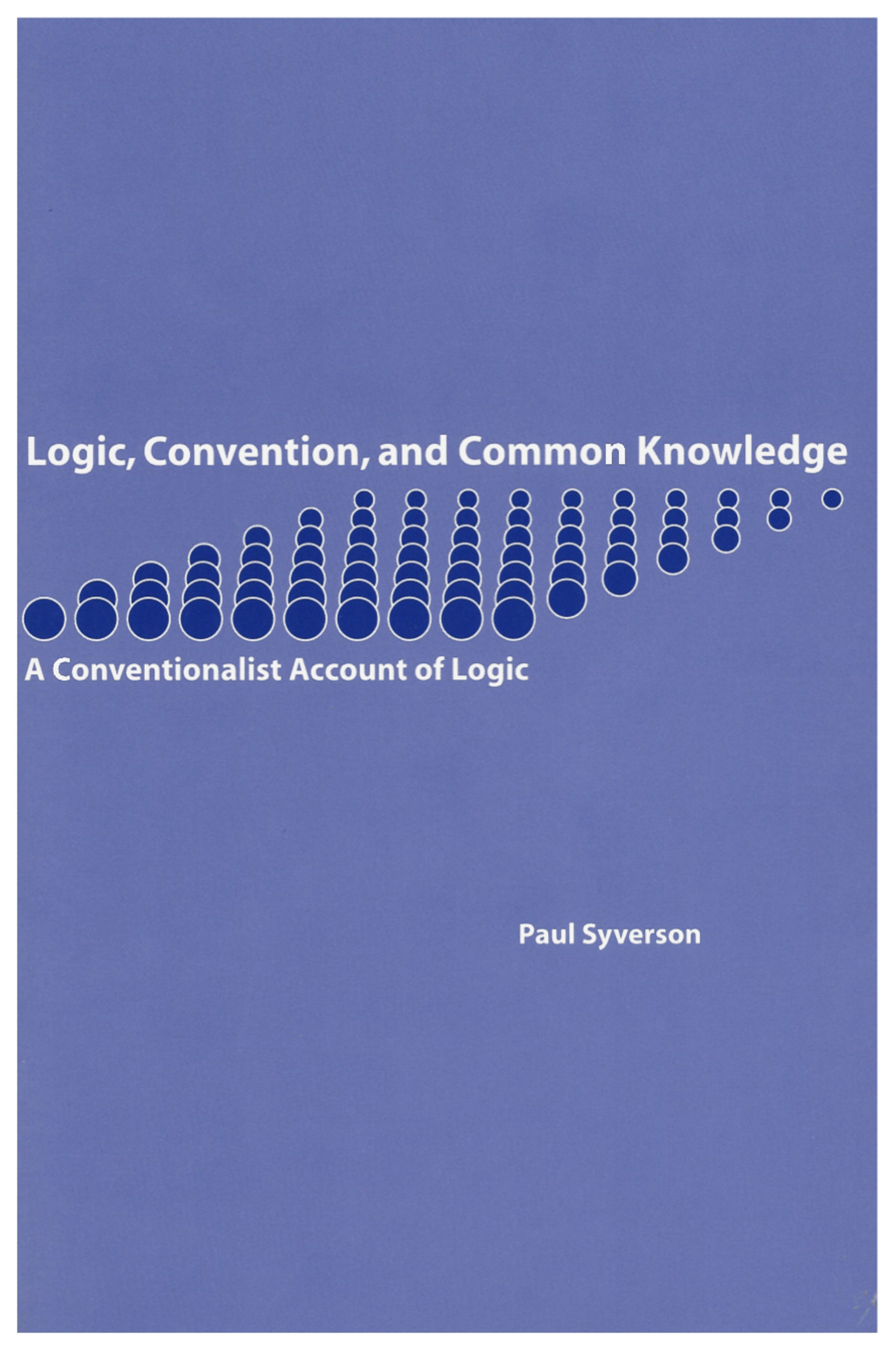
Logic, Convention, and Common KnowledgeA Conventionalist Account of Logic Logic, Convention, and Common Knowledge presents the thesis that logic is conventional, that logical consequence and logical truth are not simply given; they arise as conventions. This is a response to Quine's position that conventionalist accounts of logic must be either trivial or vacuous. Following Lewis, convention is explained within a game-theoretic framework to be a kind of equilibrium between the strategies of players. Although Lewis ultimately abandoned that account, it is argued that conventions are still reasonably treated as coordination equilibria. Convention and coordination are ordinarily assumed to require common knowledge. Barwise's shared-situation approach to common knowledge is examined in detail and illustrated by Gray's classic coordination problem from distributed computing, where two generals can only communicate with each other through unreliable means. Though this problem is widely thought to be provably unsolvable, a solution is provided—based on the limitations of the generals' reasoning abilities. Epistemic logic, expressive enough to represent and reason about common knowledge, is developed to capture such limited reasoning. The logic is shown to be sound and complete with respect to a presented situation semantics. Returning to Quine's critique and explaining how conventions can arise even when common knowledge is available only after a convention arises, this book's conclusion completes the justification for a conventionalist view of logic. is a mathematician in the Center for High Assurance Computer Systems at the Naval Research Laboratory. Read an excerpt from this book.Contents
11/1/2002 ISBN (Paperback): 1575863928 (9781575863924)
|


 Distributed by the
University of Chicago Press |
|
pubs @ csli.stanford.edu
|
CSLI Publications
Stanford University Cordura Hall 210 Panama Street Stanford, CA 94305-4101 (650) 723-1839 |