

 |


|

|
Recent Titles
 Now Available!
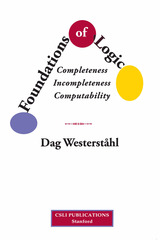
Foundations of Logic: Completeness, Incompleteness, Computability
By Dag Westerståhl
This book provides a concise but detailed account of modern logic's three cornerstones: the completeness of first-order logic, Gödel's Incompleteness Theorems, and Turing's analysis of computability. In addition to the central text, an appendix explains the required technical terminology and facts. The main ideas behind the three cornerstones are explained in a simple, easy-to-grasp manner, and it is possible to select among the chapters and sections so that the reader becomes familiar with these ideas, even if some technicalities are skipped or postponed. A wealth of exercises accompany a wide selection of materials, including the histories and philosophical implications of the three main premises, making it useful as a textbook for undergraduate or graduate courses focusing on any of the three main themes. The material is rigorous and detailed but keeps the main ideas in sight, and there are numerous excursions into more advanced material for curious readers to explore.
Order this book.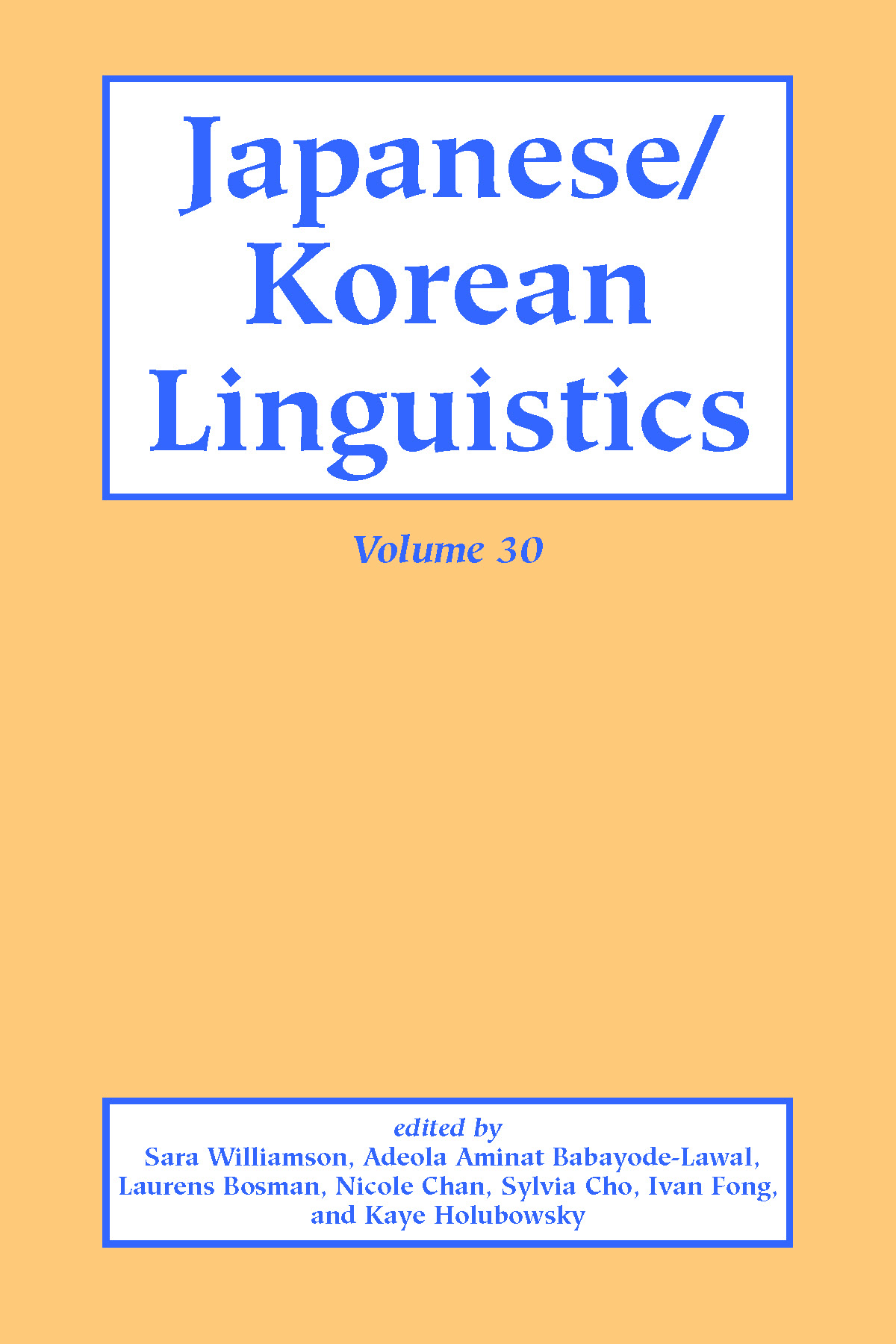 Now Available! (Online Only)
Japanese/Korean Linguistics Volume 30
Edited by Sara Williamson, Adeola Aminat Babayode-Lawal, Laurens Bosman, Nicole Chan, Sylvia Cho, Ivan Fong, and Kaye Holubowsky
Japanese and Korean are typologically similar, with linguistic phenomena in one often having counterparts in the other. The Japanese/Korean Linguistics Conference provides a forum for research, particularly through comparative study, of both languages. This online-only volume includes essays on the phonology, morphology, syntax, semantics, historical linguistics, discourse analysis, prosody, and psycholinguistics of both languages. This volume will be a useful tool for any researcher or student in either field. This volume gathers papers delivered at the 30th Japanese/Korean Linguistics Conference.
View this book Online.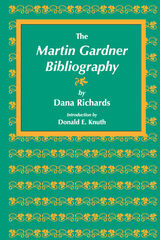 Now Available!
The Martin Gardner Bibliography
By Dana Richards
Martin Gardner (1914–2010) was a polymath whose international reputation extended from mathematics to literature, philosophy to science, and magic to fiction. This comprehensive bibliography covers every aspect of Gardner's lengthy publishing career, from 1930 to 2010, and features detailed descriptions and indexes of his writings on mathematics and many other topics. Editor Dana Richards worked directly with Gardner on this project from 1978 until Gardner's death; it draws on the two hundred boxes of Gardner's mathematical papers held in the Stanford archives.
Order this book. Now Available!
Probabilistic Approaches to Linguistic Theory
Edited by Jean-Philippe Bernardy, Rasmus Blanck, Stergios Chatzikyriakidis, Shalom Lappin, Aleksandre Maskharashvili
In this collection of papers, leading researchers in computational and formal linguistics present new approaches to the central questions of linguistic theory, explore the role of probabilistic and machine learning methods in the development of linguistic theories, and reveal new applications of recent learning and modeling methods in AI. Through a highly interdisciplinary framework, this book tackles central questions in syntax, semantics, pragmatics, sentence processing, and dialogue, offering insights that go well beyond traditional linguistic orthodoxy. New and non-traditional approaches to longstanding issues allow the researchers to challenge and set aside entrenched theories, in favor of experimentally and computationally robust new models. This book is a must-have for researchers and graduate students in linguistics, computer science (AI and NLP), psychology, and cognitive science, and a useful reference work for industrial research labs and AI systems development.
Order this book. Now Available! (Online Only)
Japanese/Korean Linguistics Volume 29
Edited by Kaoru Horie, Kimi Akita, Yusuke Kubota, David Y. Oshima, and Akira Utsugi
Japanese and Korean are typologically similar, with linguistic phenomena in one often having counterparts in the other. The Japanese/Korean Linguistics Conference provides a forum for research, particularly through comparative study, of both languages. This online-only volume includes essays on the phonology, morphology, syntax, semantics, historical linguistics, discourse analysis, prosody, and psycholinguistics of both languages. This volume will be a useful tool for any researcher or student in either field. This volume gathers papers delivered at the 29th Japanese/Korean Linguistics Conference.
View this book Online. Now Available!
Japanese/Korean Linguistics Volume 28
Edited by Hae-Sung Jeon, Pete Sells, Zixi You, Sotaro Kita & Jaehoon Yeon
Japanese and Korean are typologically similar, with linguistic phenomena in one often having counterparts in the other. The Japanese/Korean Linguistics Conference provides a forum for research, particularly through comparative study, of both languages. This volume includes essays on the phonology, morphology, syntax, semantics, historical linguistics, discourse analysis, prosody, and psycholinguistics of both languages. This volume will be a useful tool for any researcher or student in either field. This volume gathers papers delivered at the 28th Japanese/Korean Linguistics conference held virtually due to the COVID 19 pandemic.
Order this book. Now Available!
Constraint-Based Syntax and Semantics: Papers in Honor of Danièle Godard
Edited by Anne Abeillé and Olivier Bonami
This volume is devoted to the syntax and semantics of various languages, studied with models based on constraints. Both French and international linguists present their work in tribute to Danièle Godard, emeritus research director at the Centre national de la recherche scientifique in France, a member of the Laboratoire de Linguistique Formelle at Université Paris Diderot, and a specialist in the syntax and semantics of French and Romance languages.
Order this book. Now Available!
Information and Mind: The Philosophy of Fred Dretske
Edited by Paul Skokowski
This volume examines a selection of topics that Fred Dretske addressed in his philosophical career. The topics range from one of the earliest problems Dretske analyzed, the nature of seeing an object, to epistemological issues that he worked on from mid-career onwards, to issues he focused on later in his career, including information, mental represnataion, and conscious experience.
Order this book. Now Available!
Japanese/Korean Linguistics Volume 27
Michael Barrie
Japanese and Korean are typologically similar, with linguistic phenomena in one often having counterparts in the other. The Japanese/Korean Linguistics Conference provides a forum for research, particularly through comparative study, of both languages. This volume includes essays on the phonology, morphology, syntax, semantics, historical linguistics, discourse analysis, prosody, and psycholinguistics of both languages. This volume will be a useful tool for any researcher or student in either field.
This volume gathers papers delivered at the 27th Japanese/Korean Linguistics conference held in Seoul, South Korea.
Order this book. Now Available!
Form and Meaning in Language, Volume III
Charles J. Fillmore
This volume continues the collection of work by Charles J. Fillmore, which he started in 2003. Taken together, the work gathered in these volumes reflects Fillmore's desire to make sense of the workings of language in a way that keeps in mind questions of language form, language use, and the conventions linking form, meaning, and practice.
Divided into four parts, the papers collected in Volume III explore the organization of linguistic knowledge; the foundations of constructing grammar; construction grammar analyses; and constructions and language in use.
Order this book. Now Available!
Form and Meaning in Language, Volume II
Charles J. Fillmore
This volume continues the collection of work by Charles J. Fillmore, which he started in 2003. Taken together, the work gathered in these volumes reflects Fillmore's desire to make sense of the workings of language in a way that keeps in mind questions of language form, language use, and the conventions linking form, meaning, and practice.
Divided into four parts, the papers collected in Volume II explore language in use; semantics and pragmatics; text and discourse; and language in society.
Order this book. Now Available!
LingVis: Visual Analytics for Linguistics
Edited by Miriam Butt, Annette Hautli-Janisz, and Verena Lyding
This volume collects landmark research in a burgeoning field of visual analytics for linguistics, called LingVis. Combining linguistic data and linguistically oriented research questions with techniques and methodologies developed in the computer science fields of visual analytics and information visualization, LingVis is motivated by the growing need within linguistic research for dealing with large amounts of complex, multidimensional data sets. An innovative exploration into the future of LingVis in the digital age, this foundational book both provides a representation of the current state of the field and communicates its new possibilities for addressing complex linguistic questions across the larger linguistic community.
Order this book. Now Available!
Revisiting the Essential Indexical
John Perry
IN THIS BOOK, renowned philosopher John Perry responds to criticisms of his influential writing on "the essential indexical." He begins by explaining the conclusions of his past articles. He then argues that many criticisms are based on confusions about the relation between the issues opacity and cognitive significance, and other basic misunderstandings of his views. While dealing with criticisms, Perry makes a number of points about self-knowledge, the issue that motivated his original papers.
Order this book. Now Available!
Bantu Applicative Constructions
Sara Pacchiarotti
This book focuses on different clause-level constructions involving reflexes of the Proto-Bantu multifunctional applicative suffix *-ɪd. These constructions, widespread across the Bantu family, show that applicative morphology is not always syntactically valence-increasing. It performs many non-syntactic functions - some purely semantic, others related to information structure - which are often not addressed in the relevant literature.
Besides comparative data from the entire Bantu domain, this work includes a first-ever historical case study of lexicalized, valence-neutral applicative constructions in the southern Bantu language Tswana. Sara Pacchiarotti shows that several non-syntactic functions of applicative morphology in Bantu have parallels in genealogically unrelated and geographically distant language families. Such often-overlooked cross-linguistic data represent a serious challenge for most current operational definitions of applicative morphology, inside and outside of Bantu, as being ontologically a morphosyntactic valence-increasing device.
Order this book. Now Available!
Knuth par Knuth
Donald E. Knuth
The interviews in this volume form the nearest thing possible to an autobiography of eminent computer scientist Donald E. Knuth. Based on the English-language Companion to the Papers of Donald Knuth, also published by CSLI Publications, this book brings the highlights of that material to a Francophone audience.
Ce livre est la traduction des entretiens que Donald Knuth a accordés à Dikran Karagueuzian, dans lesquels il passe en revue des moments importants de sa vie permettant de mieux comprendre son œvre, que ce soit sa prime enfance et le milieu qui a formé son caractère, ses travaux d'étudiants l'ayant conduit à devenir un spécialiste des compilateurs, les raisons qui l'ont poussé à s'orienter vers la combinatoire en informatique et à l'analyse des algorithmes, sa passion pour la typographie et la création de, bien sûr, son TEX grand œvre encore non achevé: The Art of Computer Programming.
Order this book. Now Available!
Japanese/Korean Linguistics Volume 26
Shoichi Iwasaki, Susan Strauss, Shin Fukuda, Sun-Ah Jun, Sung-Ock Sohn, and Kie Zuraw
Japanese and Korean are typologically similar, with linguistic phenomena in one often having counterparts in the other. The Japanese/Korean Linguistics Conference provides a forum for research, particularly through comparative study, of both languages. This volume includes essays on the phonology, morphology, syntax, semantics, historical linguistics, discourse analysis, prosody, and psycholinguistics of both languages. This volume will be a useful tool for any researcher or student in either field.
This volume gathers papers delivered at the 26th Japanese/Korean Linguistics conference held at UCLA.
Order this book. Now Available!
Studies in Language and Information
John Perry
This volume collects twenty-five papers on the philosophical aspects of language and information written and co-written by John Perry between 1983 and 2015. Co-authors include Jon Barwise, David Israel, Syun Tutiya, Elizabeth Macken, Cathy Haas, and Krista Lawlor. The papers all represent collaborations made possible by the Center for the Study of Language and Information at Stanford. Topics include situation semantics, information and action, names and indexicals, the reflexive-referential theory, Moore's Paradox and Frege.
Order this book. Now Available!
Tokens of Meaning: Papers in Honor of Lauri Karttunen
Edited by Cleo Condoravdi and Tracy Holloway King
Lauri Karttunen has done groundbreaking work in theoretical and computational linguistics. The papers in this volume present new, state-of-the-art work building on his numerous contributions. The first part includes papers on formal semantics, the focus of Karttunen's early career to which he has returned in recent years. The second part provides a natural extension of his semantic work: the formal analysis of meaning and reasoning and the integration of the lexical and ontological components to enable reasoning by computational systems. The third part focuses on syntactic analyses, including the structure of non-finite clauses and sentence embedding predicates and factivity. The final part of the volume deals with finite state methods and grammars, reflecting Karttunen's extensive contributions to finite state theory and technology and its application to natural language.
Order this book. Now Available!
Japanese/Korean Linguistics, Vol. 25
Edited by Shin Fukuda, Mary Shin Kim, and Mee‐Jeong Park
Japanese and Korean are typologically similar, with linguistic phenomena in one often having counterparts in the other. The Japanese/Korean Linguistics Conference provides a forum for research, particularly through comparative study, of both languages. The papers in this volume are from the twenty-fifth conference, which was held at the University of Hawai'i at Mānoa. They include essays on the phonology, morphology, syntax, semantics, historical linguistics, discourse analysis, prosody, and psycholinguistics of both languages. Such comparative studies deepen our understanding of both languages and will be a useful reference for students and scholars in either field.
Order this book.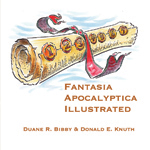 Now Available!
Fantasia Apocalyptica Illustrated
Donald E. Knuth, illustrated by Duane R. Bibby
Artist Duane Bibby brings Donald Knuth's computer-assisted musical “translation” of the biblical Book of Revelation to life in this illustrated edition of Knuth's multimedia work for pipe organ and video, Fantasia Apocalyptica. Each of Bibby's hand-painted illustrations captures an associated passage from Revelation, providing not only a vibrant and captivating complement to Knuth's music, but also the mysticism and drama of the Bible. Fantasia Apocalyptica Illustrated is a marvelous addition to the collection of any bibliophile or contemporary music aficionado.
Order this book.
 Now Available!
Revealing Structure: Papers in Honor of Larry Hyman
edited by Eugene Buckley, Thera Crane, and Jeff Good
Drawing from a wide range of perspectives in the analysis of grammatical structures, the papers collected in this book are unified not by linguistic subfield, but by the investigative method they employ in revealing grammatical patterns. Revealing Structure explores this style of investigation across phonology, morphology, and syntax. Dedicated to celebrated linguist Larry Hyman, author of such books as A Theory of Phonological Weight, this volume also features data from diverse languages—with a special emphasis on the languages of Africa‐making it unique among existing linguistics collections.
Order this book.
 Now Available!
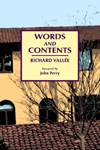
Words and Content
Richard Vallée, foreword by John Perry
The papers collected in Richard Vallée's Words and Contents span twenty‐one years of research. Beginning with referring expressions and later addressing context sensitivity, the book examines how specific words contribute to the contents of utterances and the philosophical issues that surround them. Within these papers, Vallée navigates the discovery and exploration of different modes of expression and perspectives on language.
Order this book.
 Now Available!
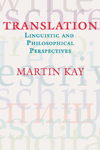
Translation: Linguistic and Philosophical Perspectives
Martin Kay
Martin Kay's Translation is concerned with the fundamental underpinnings of the titular subject. Kay argues that the primary responsibility of the translator is to the referents of words themselves. He shows how a pair of sentences that might have widely different meanings in isolation could have similar meanings in some contexts. Exploring such key subjects as how to recognize when a pair of texts might be translations of each other, Kay attempts to answer the essential question: What is translation anyway?
Order this book.
 Now Available!
Japanese/Korean Linguistics, Vol. 24
edited by Kenshi Funakoshi, Shigeto Kawahara, and Christopher D. Tancredi
Japanese and Korean are typologically similar, with linguistic phenomena in one often having counterparts in the other. The Japanese/Korean Linguistics Conference provides a forum for research, particularly through comparative study, of both languages. The papers in this volume are from the twenty-fourth conference, which was held at the National Institute for Japanese Language and Linguistics. They include essays on the phonology, morphology, syntax, semantics, historical linguistics, discourse analysis, prosody, and psycholinguistics of both languages. Such comparative studies deepen our understanding of both languages and will be a useful reference for students and scholars in either field.
Order this book.
 Now Available!
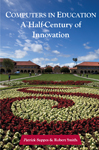
Computers in Education: A Half-Century of Innovation
Patrick Suppes and Robert Smith
Described by the New York Times as a visionary “pioneer in computerized learning,” Patrick Suppes (1922–2014) and his many collaborators at Stanford University conducted research on the development, commercialization, and use of computers in education from 1963 to 2013. Computers in Education synthesizes this wealth of scholarship into a single succinct volume that highlights the profound interconnections of technology in education. By capturing the great breadth and depth of this research, this book offers an accessible introduction to Suppes's striking work.
Order this book.
 Now Available!
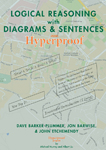
Logical Reasoning with Diagrams & Sentences: Using Hyperproof
Dave Barker-Plummer, Jon Barwise, and John Etchemendy
The Logical Reasoning with Diagrams and Sentences courseware package teaches the principles of analytical reasoning and proof construction using a carefully crafted combination of textbook, desktop, and online materials. This package is sure to be an essential resource in a range of courses incorporating logical reasoning, including formal linguistics, philosophy, mathematics, and computer science.
Order this book.
 Available Now!
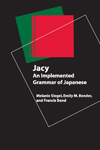
Jacy: An Implemented Grammar of Japanese
Melanie Siegel, Emily M. Bender, and Francis Bond
This book describes the fundamentals of Jacy, an implementation of a Japanese head‐driven phrase structure grammar (HPSG) with many useful linguistic implications. Jacy presents sound information about the Japanese language (syntax, semantics, and pragmatics) based on implementation and tested on large quantities of data. As the grammar development was done in a multilingual environment, Jacy also showcases both multilingual concepts and differences among the languages and demonstrates the usefulness of semantic analysis in language technology applications.
Order this book.
 Available Now!
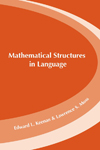
Mathematical Structures in Language
Edward L. Keenan and Lawrence S. Moss
Mathematical Structures in Language introduces a number of mathematical
concepts that are of interest to the working linguist. The areas covered include
basic set theory and logic, formal languages and automata, trees, partial
orders, lattices, Boolean structure, generalized quantifier theory, and linguistic
invariants, the last drawing on Edward L. Keenan and Edward Stabler's
Bare Grammar: A Study of Language Invariants, also published by CSLI Publications.
Order this book.
 Available Now!
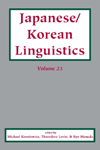
Japanese/Korean Linguistics, Vol. 23
edited by Michael Kenstowicz, Theodore Levin, and Ryo Masuda
Japanese and Korean are typologically similar, with linguistic phenomena in one often having counterparts in the other. The Japanese/Korean Linguistics Conference provides a forum for research, particularly through comparative study, of both languages. The papers in this volume are from the twenty-third conference, which was held at the Massachusetts Institute of Technology. They include essays on the phonology, morphology, syntax, semantics, historical linguistics, discourse analysis, prosody, and psycholinguistics of both languages. Such comparative studies deepen our understanding of both languages and will be a useful reference for students and scholars in either field.
Order this book.
 Available Now!
Meaning, Creativity, and the Partial Inscrutability of the Human Mind, 2nd Edition
Julius Moravcsik
In the second edition, a new theory is presented that replaces the formal semanticist's singular reference with the notion of identification that singles out elements for linguistic communities so that descriptive terms can be attached to the identification without existential import. Identification in our sense brings with it also leaving as much implicit in a communication as possible. Thus identifications are contextualized. Given the indefiniteness of the contexts, an identificational use can be expanded to cover identifications in new uses.
Order this book.
 Available Now!
Semantic Properties of Diagrams and Their Cognitive Potentials
by Atsushi Shimojima
Why are diagrams sometimes so useful, facilitating our understanding and thinking, while at other times they can be unhelpful and even misleading? Drawing on a comprehensive survey of modern research in philosophy, logic, artificial intelligence, cognitive psychology, and graphic design, Semantic Properties of Diagrams and Their Cognitive Potentials reveals the systematic reasons for this dichotomy, showing that the cognitive functions of diagrams are rooted in the characteristic ways they carry information. In analyzing the logical mechanisms behind the relative efficacy of diagrammatic representation, Atsushi Shimojima provides deep insight into the crucial question: What makes a diagram a diagram?
Order this book.
 Available Now!
Readings in Japanese Natural Language Processing
edited by Francis Bond, Timothy Baldwin, Kentaro Inui, Shun Ishizaki, Hiroshi Nakagawa, and Akira Shimazu
Readings in Japanese Natural Language Processing surveys a wide
range of texts that explore Japanese morphology and syntactic
analysis, discourse, and natural language processing applications.
Presenting such techniques in a manner accessible to those with
little or no familiarity with Japanese, these carefully selected papers
will broaden the scope of our study of Japanese linguistic phenomena,
making this collection indispensable in the field.
Order this book.
 Now Available!
Predicative Constructions: From the Freegean to a Montagovian Treatment
Frank van Eynde
Frank van Eynde develops a treatment in line with the Quine-Montague analysis of the English copula. It is based on the assumption that the syntactic and semantic structure of predicative constructions are homomorphous and it is cast in the Typed Feature Structure of Head-Driven Phrase Structure Grammar. Since this approach is new, it is motivated extensively, not only with the classical qualitative weighing of pros and cons but also with detailed quantitative investigations of treebanks.
Order this book.
 Available Now!
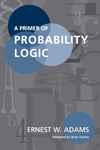
A Primer of Probability Logic
Ernest W. Adams
This book is meant to be a primer, that is, an introduction, to
probability logic, a subject that appears to be in its
infancy.Probability logic is a subject envisioned by Hans
Reichenbach and largely created by Adams. It treats conditionals as
bearers of conditional probabilities and discusses an appropriate
sense of validity for arguments such conditionals, as well as
ordinary statements as premises.The new printing of this book makes corrections to several tables and the expansive bibliography in order to create a more complete and accurate version of the text. An ebook version is now also available.
Order this book.
 Available Now!
Japanese/Korean Linguistics, Vol. 22
edited by Mikio Giriko, Naonori Nagaya, Akiko Takemura, and Timothy J. Vance
Japanese and Korean are typologically similar, with linguistic phenomena in one often having counterparts in the other. The Japanese/Korean Linguistics Conference provides a forum for research, particularly through comparative study, of both languages. The papers in this volume are from the twenty-second conference, which was held at the National Institute for Japanese Language and Linguistics. They include essays on the phonology, morphology, syntax, semantics, historical linguistics, discourse analysis, prosody, and psycholinguistics of both languages. Such comparative studies deepen our understanding of both languages and will be a useful reference for students and scholars in either field.
Order this book.
 Available Now!
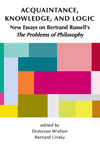
Acquaintance, Knowledge, and Logic: New Essays on Bertrand Russell's The Problems of Philosophy
Edited by Donovan Wishon and Bernard Linsky
Bertrand Russell, the recipient of the 1950 Nobel Prize for Literature, was one of the most distinguished, influential, and prolific philosophers of the twentieth century. Acquaintance, Knowledge, and Logic brings together ten new essays on Russell-s best-known work, The Problems of Philosophy. These essays, by some of the foremost scholars of his life and works, reexamine Russell's famous distinction between “knowledge by acquaintance” and “knowledge by description,” his developing views about our knowledge of physical reality, and his views about our knowledge of logic, mathematics, and other abstract matters. In addition, this volume includes an editors' introduction, which summarizes Russell's influential book, presents new biographical details about how and why Russell wrote it, and highlights its continued significance for contemporary philosophy.
Order this book.
 Available Now!
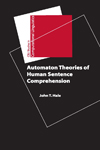
Automaton Theories of Human Sentence Comprehension
John T. Hale
Different kinds of grammars may actually be used in models of perceptual processing. By relating grammars to cognitive architecture, John T. Hale shows step-by-step how incremental parsing works and how specific learning rules might lead to frequency-sensitive preferences. Along the way, this book reconsiders garden-pathing, the parallel/serial distinction and information-theoretical complexity metrics, such as surprisal. This book is a must for cognitive scientists of language.
Order this book.
 Available Now!
Foundations and Methods from Mathematics to Neuroscience: Essays Inspired by Patrick Suppes
edited by Colleen E. Crangle, Adolfo García de la Sienra, and Helen E. Longino
Patrick Suppes and his peers explore a diverse array of topics including the relationship between science and philosophy; the philosophy of physics; problems in the foundations of mathematics; theory of measurement, decision theory, and probability; the foundations of economics and political theory; psychology, language, and the philosophy of language; Suppes's most recent research in neurobiology; and the alignment (or misalignment) of method and policy.
Order this book.
 Available Now!
Language and the Creative Mind Mike Borkent, Barbara Dancygier, Jennifer Hinnell
This volume brings together papers from the 11th Conceptual Structure,
Discourse and Language Conference, held in Vancouver in May 2012. In
the last few years, the cognitive study of language has begun to
examine the interaction between language and other embodied
communicative modalities, such as gesture, while at the same time
expanding the traditional limits of linguistic and cognitive enquiry
into creative domains such as music, literature, and visual
images. Papers in this collection show how the study of language paves
the way for these new areas of investigation. They bring issues of
multimodal communication to the attention of linguists, while also
looking through and beyond language into various domains of human
creativity. This refreshed view of the relations across various
communicative domains will be important not only to linguists, but
also to all those interested in the creative potential of the human
mind.
Order this book.
 Available Now!
Japanese/Korean Linguistics, Vol. 21
Edited by Seungho Nam, Heejeong Ko, and Jongho Jun
The Japanese/Korean Linguistics Conference is a site for research on Japanese and Korean in a variety of areas, as well as comparative research on similarities and differences between the two languages. The papers included in this volume are from the 21st Japanese/Korean Linguistics Conference, which was held at Seoul National University. The contributions include studies in syntax, semantics, phonology, prosody, psycholinguistics, dialects, discourse, functional linguistics, and the the first and second language acquisition. This volume deepens our understanding of both languages and provide a useful reference for students and scholars in these fields.
Order this book.
 Available Now!
What Is Said and What Is Not
Carlo Penco and Filippo Domaneschi
This volume contains essays that explore explicit and implicit
communication through linguistic research. Taking as a framework Paul Grice's
theories on “what is said,” the contributors explore a number of areas, including:
the boundary between semantics and pragmatics; the concept of implicit
communication; the idea of the logical form of our assertions; the notion
of conventional meaning; the phenomenon of deixis, which refers to when an
utterance require context in order to be understood fully; the treatment
of definite descriptions; and the different kinds of pragmatic processes.
Order this book.
 Available Now!
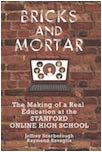
Bricks and Mortar: The Making of a Real Education at the Stanford Online Highschool
Jeffrey Scarborough and Raymond Ravaglia
This volume shows how a group of online-learning believers bult the best high school in the world without laying a single brick: the Stanford Online High School (SOHS). By chronicling SOHS's distinctive approach to curriculum, gifted education, school community over SOHS's first seven years, Bricks and Mortar makes the case that the dynamic use of technology and the best traditional methodologies in education are not, in fact, mutually exclusive. Indeed, while SOHS has redefined what is possible online, a great education is ultimately the product of an interactive community of teachers and students.
Order this book.
 Available Now!
Japanese/Korean Linguistics, Vol. 20 edited by Bjarke Frellesvig and Peter Sells
Japanese and Korean are typologically similar, with linguistic phenomena
in one often having counterparts in the other. The Japanese/Korean
Linguistics Conference provides a forum for research, particularly through
comparative study, of both languages. This volume includes essays on the
phonology, morphology, syntax, semantics, historical linguistics,
discourse analysis, prosody, and psycholinguistics of both languages. This
volume will be a useful tool for any researcher or student in either
field.
Order this book.
 Available Now!
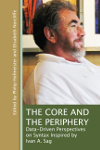
The Core and the Periphery: Data-Driven Perspectives on Syntax inspired by Ivan A. Sag edited by Philip Hofmeister and Elisabeth Norcliffe
The Core and the Periphery is a collection of papers inspired by the
linguistics career of Ivan A. Sag (1949–2013), written to commemorate his
many contributions to the field. Sag was professor of linguistics at
Stanford University from 1979 to 2013; served as the director of the
Symbolic Systems Program from 2005 to 2009; authored, co-authored, or
edited fifteen volumes on linguistics; and was at the forefront of
non-transformational approaches to syntax. Reflecting the breadth of s
theoretical interests and approaches to linguistic problems, the papers
collected here tackle a range of grammar-related issues using corpora,
intuitions, and laboratory experiments. They are united by their use of
and commitment to rich datasets and share the perspective that the best
theories of grammar attempt to account for the full diversity and
complexity of language data.
Order this book.
 Available now!
Individual Difference in Online Computer-based Learning: Gifted and Other Diverse Populations Patrick Suppes
In 1894 John Dewey established his experimental laboratory school at the University of Chicago, with a focus on teaching each student according to their individual differences. This concept indicated a shift away from the emphasis on communal, classroom teaching, which marked educational practices in the nineteenth century during the advent of widely available public education.
With the introduction of computer-based online instruction in schools,
curricula are able to be fully informed by individual difference, subtly
and quickly tracking students' progress. In these courses, teachers play the role
of troubleshooters instead of lecturers. Individual Differences examines a
large number of studies on computer-based and online instruction, with
special attention paid to gifted students in the fields of mathematics,
science, technology, and engineering. Other chapters also focus on a wide
variety of student populations: deaf students, American Indian rural
students, and underachieving, impoverished students.
Order this book.
 Available Now!
New Studies in Weak Arithmetics Edited by Patrick Cégielski, Charalampos Cornaros, and Costas Dimitracopoulos
The field of weak arithmetics is application of logical methods to Number
Theory, developed by mathematicians, philosophers, and theoretical
computer scientists. In this volume, after a general presentation of weak
arithmetics, the following topics are studied: the properties of integers
of a real closed field equipped with exponentiation; conservation results
for the induction schema restricted to first-order formulas with a finite
number of alternations of quantifiers; a survey on a class of tools,
called pebble games, used in finite model theory; the fact that reals e
and π have approximations expressed by first-order formulas using
bounded quantifiers; properties on infinite pictures depending on the
universe of sets used; a language that simulates in a sufficiently nice
manner all algorithms of a certain restricted class; the logical
complexity of the axiom of infinity in some variants of set theory without
the axiom of foundation; and the complexity to determine whether a trace
is included in another one.
Order this book.
 Available Now!
Formal Methods and Empirical Practices: Conversations with Patrick Suppes Roberta Ferrario and Viola Schiaffonati
The philosopher Patrick Suppes has developed a unique and influential
approach to studying the foundations of science—he combines an
understanding of the main principles of scientific theories in
axiomatic terms and formal models with a hands-on approach. While
moving the study of the philosophy of science out of the parlor and
into the lab, he often comes up with original results from the
psychology of learning to the theory of measurement and quantum
mechanics. This book searches for a common thread in Suppes's
multifaceted work through a series of conversations with the man
himself and illuminates many of the more challenging aspects of his
philosophy.
Order this book.
 Available Now!
Attitudes De Se: Linguistics, Epistemology, Metaphysics
edited by Neil Feit and Alessandro Capone
In English, we use the word “I” to express thoughts that we have about ourselves, and we use the reflexive pronouns “himself” and “herself” to attribute such thoughts to others. Philosophers and linguists call such thoughts, and the statements we use to express them, de se.
De se thoughts and statements, although they appear often in our
day-to-day lives, pose a series of challenging problems for both linguists
and philosophers. This interdisciplinary volume examines the structure of
de se thought, various issues concerning the semantics and pragmatics of
our discourse about it, and also what it reveals about how humans think
about themselves and the world around them.
Order this book.
 Available Now!
Identity, Language, and Mind edited by Albert Newen and Raphael van Riel
As one of the world's most eminent living philosophers, John Perry has
covered a remarkable breadth of subjects in his published work,
including semantics, indexicality, self-knowledge, personal
identity, and consciousness. Looking particularly at the way in
which he deals with issues of self, communication, and reality, this
volume is organized in seven chapters that highlight a different
aspect of Perry's work on the intersection of these subjects. A
fundamental work for students and scholars, Identity, Language, and
Mind explores questions that are not only essential in understanding
Perry's writings, but also contemporary philosophy as a whole.
Order this book.
 Online
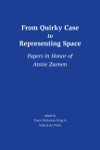
From Quirky Case to Representing Space: Papers in Honor of Annie Zaenen edited by Tracy Holloway King and Valeria de Paiva
Annie Zaenen's broad influence on the field of linguistics ranges from details of lexical representation to the architecture of formal linguistic theories. The fifteen contributed papers in this volume reflect three major themes from her research: Mapping from arguments to syntax; Views on syntax; Semantics and beyond.
 Available Now!
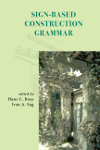
Sign-Based Construction Grammar edited by Hans C. Boas and Ivan A. Sag
This volume provides a general overview of Sign-Based Construction
Grammar (SBCG), the synthesis of Berkeley Construction Grammar and
Head-Driven Phrase Structure Grammar that emerged from a decade of
interactions between Ivan Sag, Charles Fillmore, Paul Kay and Laura
Michaelis. The papers collected here also demonstrate the analytic
value of SBCG for a variety of linguistic problems—some old
chestnuts, others untouched by ‘mainstream’ theories.
Order this book.
 Available Now!
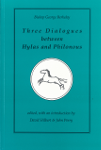
Three Dialogues between Hylas and Philonous George Berkeley (Edited, with an Introduction by David Hilbert and John Perry)
Deeply original, inspiring to some, abhorrent to others, George Berkeley's
philosophy of immaterialism is still influential three hundred years after
the publication of his most widely read book, Three Dialogues Between
Hylas and Philonous. Berkeley published the Dialogues because of the
unenthusiastic reception of his Principles of Human Knowledge in 1710. He
hoped the use of the dialogue format would win a more favorable hearing,
but unfortunately for Berkeley, the response was every bit as scathing as
the reception of his previous work. In recent decades, In recent decades,
Berkeley's work has been recognized as an excellent introduction to the English
philosophy of the eighteenth century, and to philosophy in general. This
edition of the dialogues is accessibly organized by David Hilbert and John
Perry.
Order this book.
 Available Now!
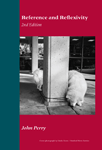
Reference and Reflexivity, 2nd edition John Perry
In this volume John Perry develops his “reflexive-referential” account
of indexicals, demonstratives, proper names, and other fragments of
language. On issues of meaning and reference, the philosophy of
language in the twentieth century was shaped by two competing
traditions, descriptivist and referentialist. The referentialist
tradition holds that indexicals, demonstratives, and proper names
contribute content that involves individuals without identifying
conditions on them. In contrast, the descriptivist tradition holds
that referential content does not explain all of the identifying
conditions conveyed by names, demonstratives, and indexicals.
Perry's theory, borrowing ideas from both traditions as well as from
Burks and Reichenbach, diagnoses the problems as stemming from a
fixation on a certain kind of content, coined “referential” or
“fully incremental” content. He reveals a coherent and structured
family of contents—from reflexive contents that place conditions on
their actual utterance to fully incremental contents that place
conditions only on the objects of reference—reconciling the
legitimate insights of both the referentialist and descriptivist
traditions.
Order this book.
CSLI Standards
 New Edition!
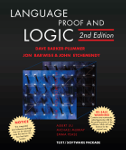
Language, Proof and Logic (second edition) Dave Barker-Plummer, Jon Barwise and John Etchemendy
This textbook/software package is a self-contained introduction to
the basic concepts of logic: language, truth, argument, consequence,
proof and counterexample. No prior study of logic is assumed, and, it
is appropriate for introductory and second courses in logic.
The unique
on-line grading service almost instantly grades solutions to hundred of
computer exercises. It is specially devised to be used by philosophy
instructors in a way that is useful to undergraduates of philosophy,
computer science, mathematics, and linguistics.
Order this book.
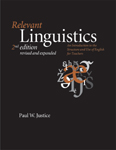 Relevant Linguistics, 2nd Edition, Revised and Expanded: An Introduction to the Structure and Use of English for Teachers
by Paul Justice.
Relevant Linguistics, 2nd Edition, Revised and Expanded: An Introduction to the Structure and Use of English for Teachers
by Paul Justice.
The revised and expanded edition of Relevant Linguistics provides a
straightforward, accessible introduction to the basics of English
phonetics, phonology, morphology, morphophonology, and syntax for
education students and all non-linguistics majors.
Order this book.
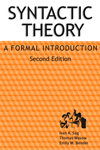 Syntactic Theory, 2nd edition: A Formal Introduction
by Ivan A. Sag, Thomas Wasow, and Emily M. Bender.
Syntactic Theory, 2nd edition: A Formal Introduction
by Ivan A. Sag, Thomas Wasow, and Emily M. Bender.
The second edition of Syntactic Theory: A Formal Introduction expands
and improves on a truly unique introductory syntax textbook. Like the
first edition, it focuses on the development of precisely formulated
grammars whose empirical predictions can be directly tested.
Order this book.
Please note: Our books are distributed by The University of Chicago Press. Please see our order page for order information.
Visit our catalog to view a chronologically ordered guide to all our publications, or use the new books area to browse our most recent publications. See also our online publications. You may also see a complete, one page summary of all our publications on the series page. Contact us or search our site in any field.
|
pubs @ csli.stanford.edu
|
CSLI Publications
Stanford University Cordura Hall 210 Panama Street Stanford, CA 94305-4101 (650) 723-1839 |